Shopify sales tax 2026: a practical playbook for Amazon/Etsy/eBay sellers
Running Amazon, Etsy, or eBay plus your own Shopify store? Here’s the 2026 sales‑tax + 1099 playbook: what marketplaces collect vs what you owe, states dropping the 200‑transaction test, and your Q4 close + 1099 checklist.
12 min read
You’re packing Q4 orders on a Sunday night when a customer pings, “Will I be charged tax?” Meanwhile, you’re selling on Amazon and Etsy, and your Shopify sales are finally humming. This guide gives you the 2026 answer, fast: how Shopify sales tax 2026 actually works beside marketplaces, which states dropped the 200‑transaction test, and what to do for this year’s 1099s.
Key takeaways
- Marketplaces (Amazon/Etsy/eBay) generally collect and remit sales tax on facilitated orders; your own Shopify/WooCommerce orders are still on you where you have nexus.
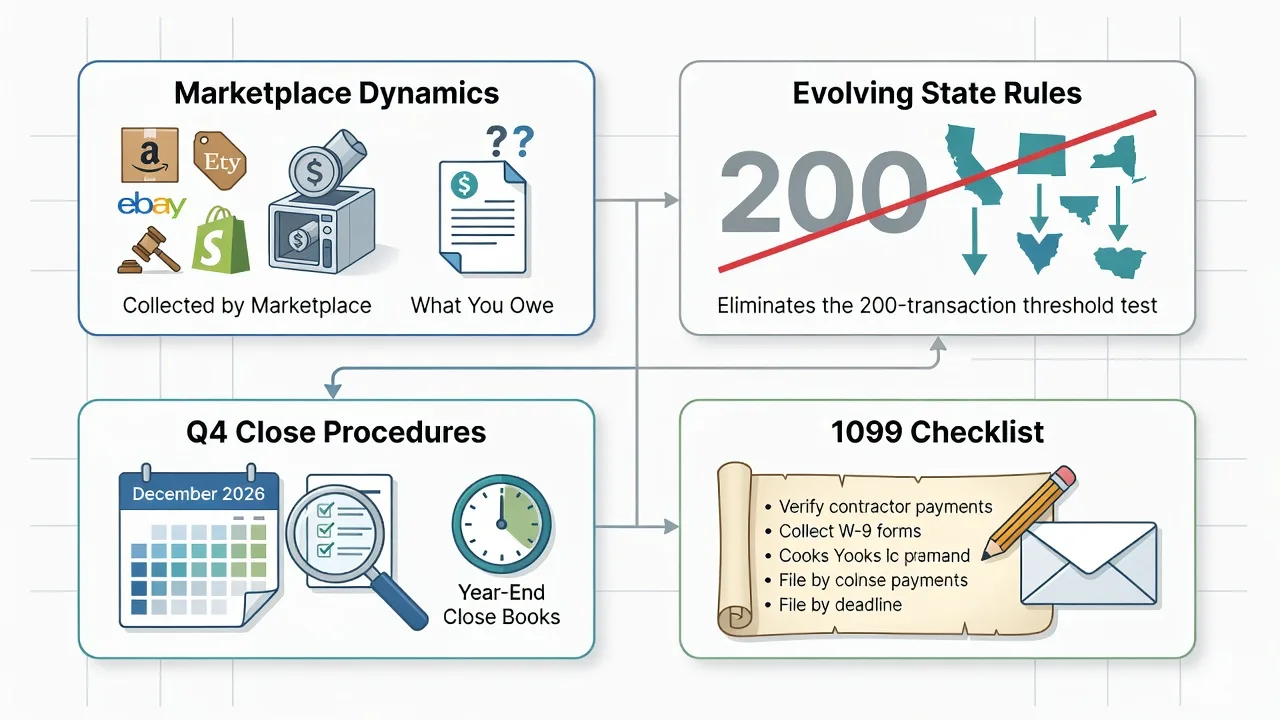
- Illinois (Jan 1, 2026) and Kentucky (Aug 1, 2026) removed the 200‑transaction nexus test; many states now use sales‑only thresholds—confirm each state you sell into (IL DOR, KY HB 757, trend).
- 1099‑K for 2026 generally applies if payments exceed $20,000 and more than 200 transactions; payment card transactions are reported regardless of amount (IRS). 1099‑NEC reporting threshold rises to $2,000 for 2026 payments (IRS IRB).
- Keep marketplace‑collected tax and your direct‑store tax in separate buckets for reporting and filings (best practice).
What marketplaces collect vs. what you still owe
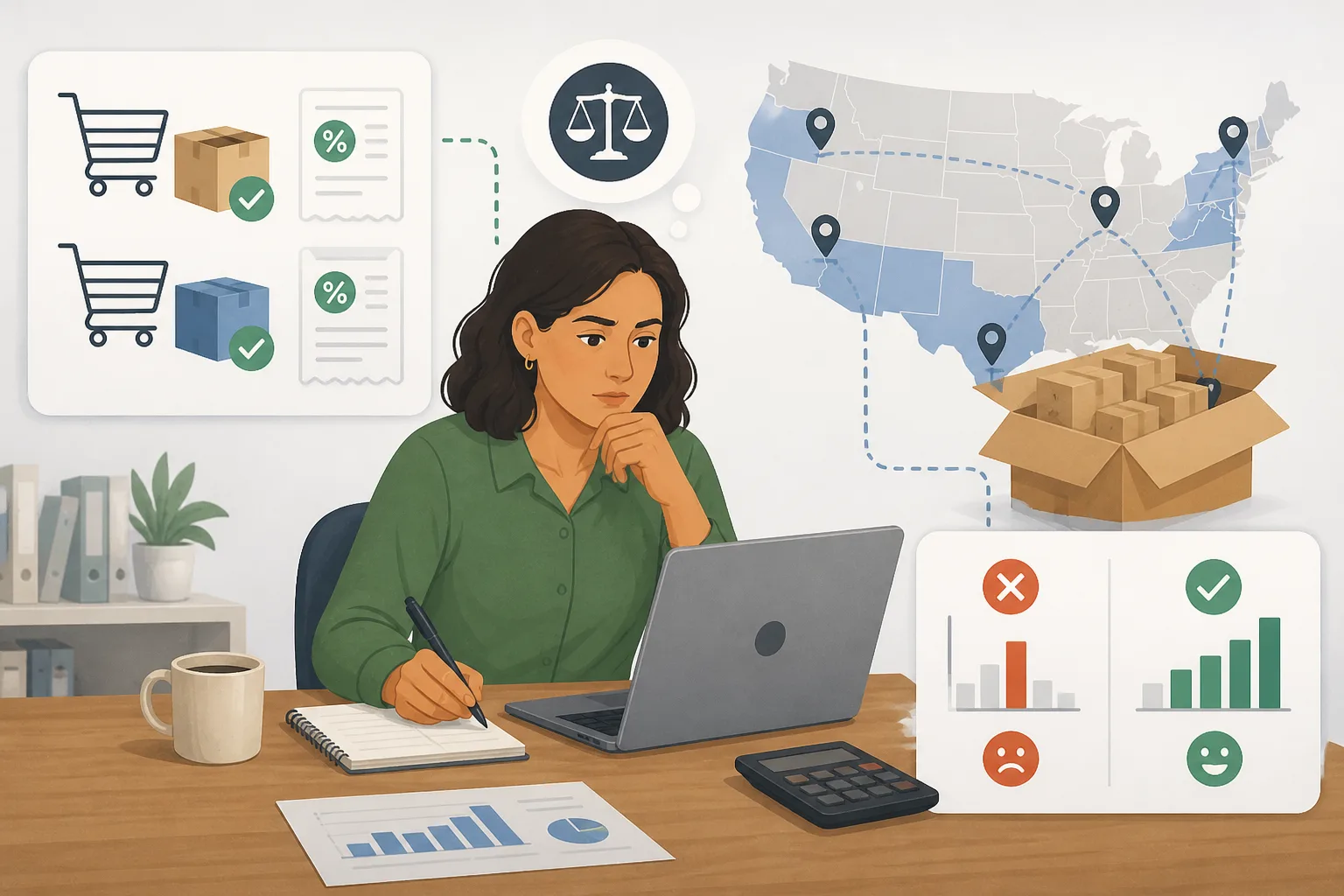
Marketplace facilitator rules mean platforms like Amazon, Etsy, and eBay register and collect tax on “facilitated” marketplace orders once they trigger a state’s requirement. Sellers generally don’t collect or remit on those marketplace orders themselves—but you still must handle tax on your direct‑channel site wherever you have nexus.
Two gotchas to watch:
- Some states count marketplace sales toward your own economic nexus threshold, even though the marketplace remits. Cross the threshold and you usually must register and collect on your Shopify/WooCommerce orders into that state.
- A few states may still expect marketplace‑only sellers to register or file “zero” returns. That’s state‑specific—check each department of revenue before changing your process.
If you sell with Amazon FBA, the marketplace still handles tax on your Amazon marketplace orders under marketplace facilitator rules in most states. That doesn’t cover your Shopify orders; configure and collect there where you have nexus.
Economic nexus states 2026: what changed and what to verify
The 200‑transaction test is fading. Two headline changes for 2026:
- Illinois removed the 200‑transaction test effective January 1, 2026; remote seller nexus is based on $100,000 in Illinois receipts (IL DOR FY 2026‑12).
- Kentucky removed the 200‑transaction test effective August 1, 2026; remote retailers and marketplace providers use a $100,000 sales‑only threshold (KY HB 757).
Many other states now use sales‑only nexus thresholds. Reports list states such as CA, CO, IN, IA, LA, ME, MA, NC, ND, SD, UT, WA, WI, WY among those moving away from the 200‑transaction test. Treat that as a trend signal, not a filing green light—always confirm on each state’s DOR page before changing registration or collection (trend tracker).
| State | 2026 threshold snapshot | 200‑transaction test? | Effective date |
|---|---|---|---|
| Illinois | $100,000 receipts | No | Jan 1, 2026 (source) |
| Kentucky | $100,000 receipts | No | Aug 1, 2026 (source) |
Practical rule of thumb: Maintain a state list with your rolling 12‑month sales into each state. When you cross a state’s current threshold, register and start collecting on your direct‑channel sales there. In states that count marketplace sales toward your threshold, include those volumes in the analysis.
Channel‑by‑channel playbook for 2026 (Amazon/Etsy/eBay + Shopify/Woo)
Marketplaces: the “what to save, what to skip” routine
- Save the marketplace certifications and monthly/quarterly tax reports. These show the platform collected and remitted on your facilitated orders.
- Check your registration status by state. If you only sell through marketplaces in a state, confirm if you must register or file zero returns anyway—it varies.
- Bookkeeping tip: Record marketplace‑collected tax as a pass‑through you don’t owe (it shouldn’t inflate your tax payable). Keep those transactions separate from your direct‑store tax bucket (best practice).
Worked example: Say you run a two‑person candle shop.
- 2026 Amazon sales into Illinois: $78,000 across 1,100 orders. Amazon collects and remits on those.
- 2026 Shopify sales into Illinois: $26,000 across 140 orders.
Illinois uses a $100,000 sales‑only threshold in 2026 (IL DOR). If Illinois counts marketplace sales toward your threshold (state‑specific; confirm), your combined sales could put you over—meaning you’d register and collect on your Shopify orders into IL while Amazon keeps collecting on Amazon orders (state‑by‑state concept).
Shopify/WooCommerce: turn on and target the right states
Shopify doesn’t automatically collect U.S. sales tax. You have to enable collection and tell it where you have nexus. From there, Shopify Tax can calculate rates and produce jurisdiction‑level detail for filings, and it offers compliance tools and reports you can export.
Set it up like a pro:
- Map states: Keep a spreadsheet with your physical presence states and your economic nexus trigger states (use the updated 2026 thresholds you’ve verified).
- Flip the switches only where you’re registered: In Shopify, enable collection only in states where you’ve registered. Don’t collect first and hope to figure out registration later.
- Separate channels in your reports: Tag marketplace vs direct‑channel orders so marketplace‑collected tax is excluded from your returns (best practice).
- Sanity check rates on a few test orders per state each quarter.
Bookkeeping view: In your chart of accounts, use two liabilities—“Sales tax payable — Shopify” and “Sales tax — marketplace collected (info only).” That keeps your return amounts clean and your audit trail obvious. If you use Stripe or Square for your shop, BookNerd Pro can sync payouts and automatically split them into sales, sales tax, tips, and fees against the matching bank deposit. It makes month‑end less… squinty.
- BookNerd has automatic bank sync, P&L and balance sheet, and tax‑time exports. If you’re still in spreadsheets, you can try it free for 15 days at booknerd.io/signup.
For more on avoiding double‑counting tax and still meeting nexus rules across channels, see our guide: Marketplace Facilitator Tax Traps: Don’t Double Count or Miss Nexus.
How to track marketplace‑collected vs your own sales tax
Here’s a tight monthly routine you can run in under an hour once it’s set up:
- Export platform reports:
- Amazon/Etsy/eBay: tax collected and remitted by jurisdiction.
- Shopify: the U.S. sales tax report with state/county/city detail (Shopify reporting).
- Reconcile by state:
- Confirm marketplace totals for the month equal “tax collected by marketplace” in your books (info‑only bucket).
- Sum Shopify tax‑collected by state and compare to your sales tax payable liability.
- File and pay:
- File only your direct‑channel tax for registered states. Exclude marketplace‑collected tax from returns where the facilitator remits (best practice).
- Threshold watchlist:
- Maintain a 12‑month rolling sales chart per state that includes marketplace and direct sales if the state counts both toward nexus (state‑level concept).
Quick QA habit: Each quarter, pick one state and trace one order from checkout to tax line on the return. If the numbers line up without mental gymnastics, you’re in good shape.
1099s in 2026: what changed and what to do
1099‑K: the 2026 threshold is $20,000 and 200 transactions
For tax year 2026, third‑party settlement organizations (marketplaces, payment apps) generally issue Form 1099‑K when your gross payments for goods/services are more than $20,000 and the number of transactions is more than 200 (IRS; IRS IR‑2026‑03). Payment card transactions (credit/debit) are reported regardless of amount (IRS). Income is taxable whether or not you get a form (IRS).
- Example: You receive $28,500 via an online marketplace across 245 transactions in 2026. You’ve exceeded both tests, so expect a 1099‑K for that platform/payee (IRS threshold).
- If you use Shopify Payments or Stripe for your store, your Shopify 1099‑K (or processor 1099‑K) generally arrives only if you exceed $20,000 and 200 transactions on that processor/account (IRS).
1099‑NEC and 1099‑MISC: threshold rises to $2,000 for 2026 payments
For payments made on or after January 1, 2026, the general reporting threshold under sections 6041/6041A increases from $600 to $2,000, with inflation indexing beginning after 2026 (IRS IRB 2026‑19; IRS training script). For 2026 payments:
- 1099‑NEC due to recipients and the IRS by Monday, February 1, 2027 (Jan 31 is a Sunday; deadlines roll to the next business day) (Instructions for Forms 1099‑MISC and 1099‑NEC).
- 1099‑MISC IRS e‑file due March 31, 2027 (standard rule; confirm category‑specific nuances) (Publication 1099 general instructions).
- Don’t issue a 1099‑NEC for amounts you paid by credit card or a third‑party network—those, if reportable, are covered by the payment settlement entity on Form 1099‑K (form instructions).
And a heads‑up for e‑filers: The IRS FIRE system retires after November 19, 2026. Beginning January 1, 2027, the IRIS platform is the way to e‑file information returns—register early if you file in‑house (IRS IR‑2026‑99).
| Form | 2026 trigger (high level) | Who issues | Recipient due | IRS e‑file due |
|---|---|---|---|---|
| 1099‑K | >$20,000 AND >200 transactions on a marketplace/app; card transactions may be reported at any amount | Marketplace/app or card processor | Jan 31, 2027 (next biz day: Feb 1, 2027) | Mar 31, 2027 (Publication 1099 — General Instructions) |
| 1099‑NEC | ≥$2,000 nonemployee comp paid in 2026 (exceptions apply) | Your business | Feb 1, 2027 | Feb 1, 2027 (IRS) |
| 1099‑MISC | Category‑specific (e.g., rents, prizes); many items at ≥$2,000 | Your business | Jan 31, 2027 | Mar 31, 2027 (IRS) |
Q4 ecommerce bookkeeping checklist (sales tax + 1099 season)
- Refresh your nexus map: Mark states that dropped the 200‑transaction test in 2026 and confirm thresholds on each DOR site (IL, KY, trend).
- Shopify/Woo tune‑up: Verify tax is enabled only in registered states and run a spot‑check of rates (Shopify guide).
- Separate the buckets: Reconcile marketplace‑collected vs direct‑channel tax; fix any orders in the wrong bucket (best practice).
- Collect W‑9s now from contractors and landlords so you’re not chasing them on January 30.
- Mark 1099 deadlines: 1099‑NEC due Feb 1, 2027; 1099‑MISC e‑file due Mar 31, 2027 (IRS; IRS).
- Apply the new thresholds: Use $2,000 for 1099‑NEC/MISC 2026 payments; don’t send 1099‑NEC for card/TPSO payments (IRS IRB; instructions).
- Prep for IRIS e‑file: If you e‑file 1099s yourself, register for IRIS well before January (IRS IR‑2026‑99).
- Consider a tool upgrade: If reconciling payouts and tax buckets is dragging, BookNerd Pro syncs Stripe/Square payouts and splits sales/tax/fees automatically, and our AI receipt capture keeps support docs with the right transactions. Also see: How AI Can Make Small‑Business Accounting Easier.
Frequently asked questions
What is the 1099‑K threshold for 2026—and does the 200‑transaction rule still apply?
Yes, for 2026 the general federal standard is “over $20,000 and more than 200 transactions” for third‑party settlement organizations. Marketplaces/apps issue 1099‑K when both tests are met; card processors may report at any amount. Your income is taxable even if you don’t receive a form (IRS; IRS).
Do I need to register and collect sales tax on my Shopify store if Amazon already collects on marketplace orders?
Usually, yes—if you have nexus in that state. Marketplace facilitator rules cover the marketplace orders only. Your direct‑channel Shopify/Woo orders are your responsibility once you have nexus. Some states also count marketplace sales toward your own threshold—confirm state rules before deciding (overview; state‑level concept).
Which states dropped the 200‑transaction nexus test for 2026? What about Illinois and Kentucky?
Illinois removed the 200‑transaction test effective Jan 1, 2026 (IL DOR). Kentucky removed it effective Aug 1, 2026 (HB 757). Many other states now use sales‑only thresholds; check each state’s DOR page before changing registrations (trend tracker).
What changed for 1099‑NEC/1099‑MISC in 2026—and what are the 2027 deadlines?
The general federal reporting threshold increases to $2,000 for payments made in 2026, with inflation indexing after 2026. 1099‑NEC is due to recipients and the IRS by Monday, Feb 1, 2027; 1099‑MISC e‑file is due Mar 31, 2027. Don’t issue 1099‑NEC for amounts you paid by card/TPSO (IRS IRB; instructions; general instructions).
If I paid a contractor by credit card or PayPal, do I still send a 1099‑NEC?
No. Don’t send 1099‑NEC for amounts paid by credit card or third‑party network. If reporting is required, the payment settlement entity handles it on Form 1099‑K. Keep good records anyway; the contractor’s income is still taxable (IRS instructions).
Ready for a calmer January? Pick one state today, verify its 2026 threshold, register if needed, and turn on collection in Shopify. Tomorrow, run the monthly routine to separate marketplace‑collected vs your own tax. Two small wins; a lot less Sunday‑night stress.
Sources & references
- Prepare to file in 2026: Get Ready for tax season with key updates and essential tips
- Treasury, IRS issue proposed regulations reflecting changes ... to the threshold for backup withholding on certain payments made through third parties (IR‑2026‑03)
- The Working Families Tax Cuts: What gig economy workers should know
- Internal Revenue Bulletin 2026‑19
- Understanding the Working Families Tax Cuts — Business Tax Provisions (IRS video text script)
- Instructions for Forms 1099‑MISC and 1099‑NEC
- Publication 1099 — General Instructions
- IRS reminder: Information Return e‑File system transitioning to a new platform (IR‑2026‑99)
- Illinois Department of Revenue Bulletin FY 2026‑12
- Kentucky HB 757 (2026 Regular Session)
- States eliminating economic nexus transaction thresholds (Avalara)