Marketplace Facilitator Tax Traps: Don’t Double Count or Miss Nexus
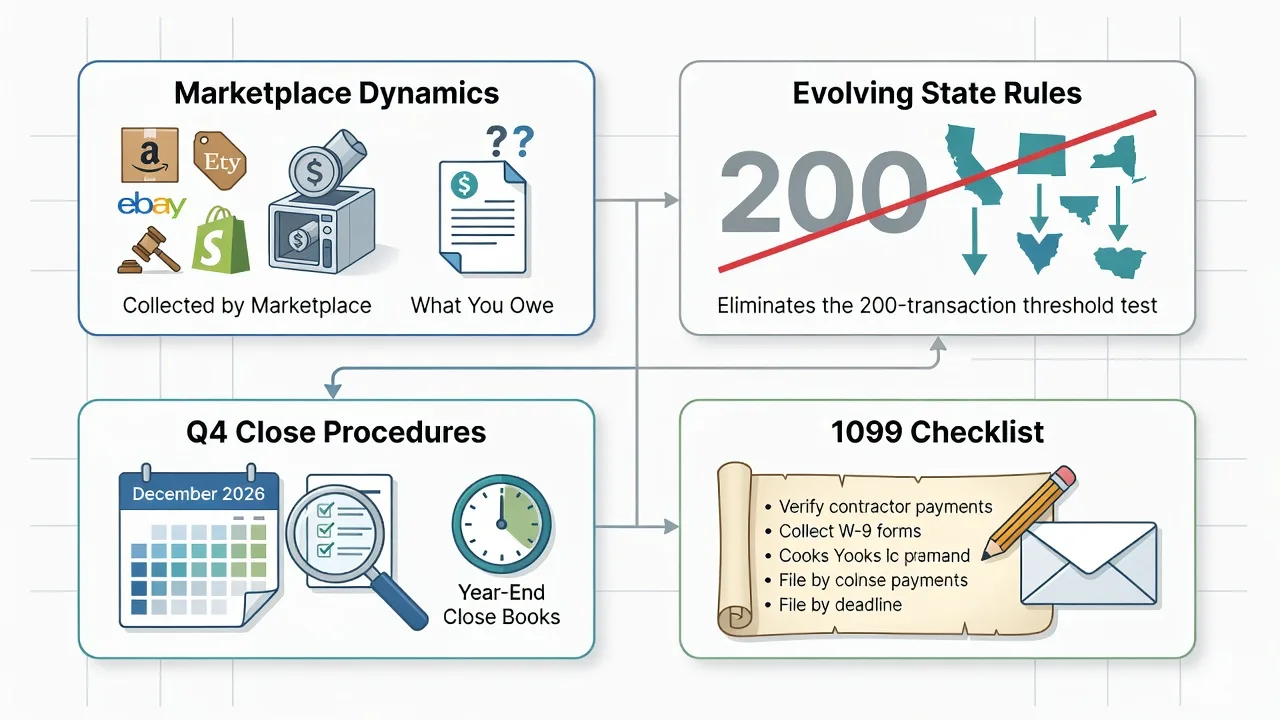
Amazon and Walmart often collect sales tax for you but you can still overpay by counting that tax as revenue, or underpay by ignoring nexus from combined marketplace + Shopify sales or FBA inventory.
11 min read
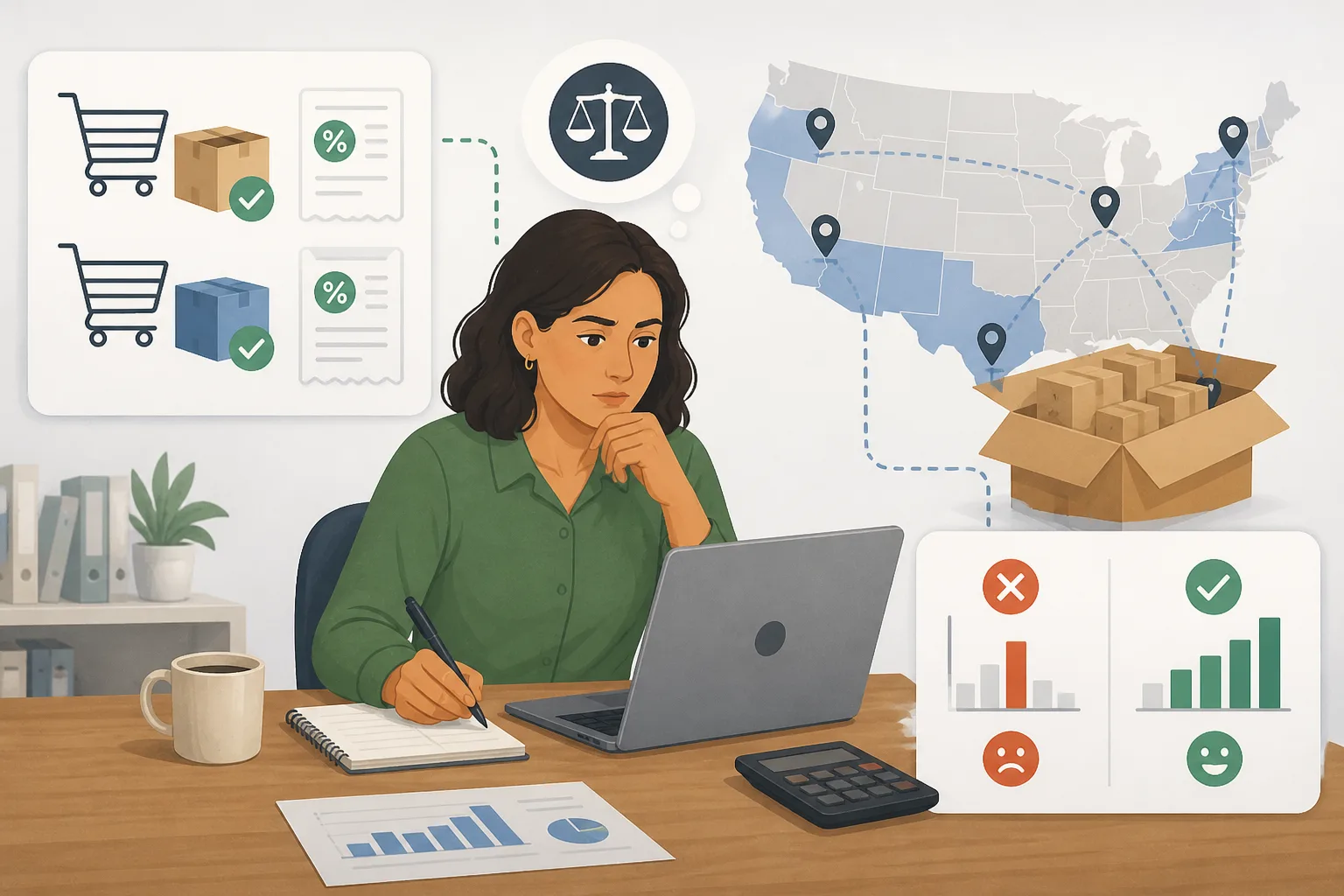
You’re closing the month and your Amazon report shows sales tax collected. Shopify shows tax too. Your 1099-K is bigger than your P&L. And California keeps sending scary emails about “nexus.” Take a breath. Marketplace facilitator tax rules are supposed to help, but they create two classic traps: double counting tax as revenue and missing nexus triggered by your combined sales.
Key takeaways
- Don’t book marketplace-collected tax (Amazon, Walmart, eBay) as your revenue or your liability.
- For nexus tests, some states count your marketplace sales with your Shopify sales (CA, TX, NY, WA), while others exclude facilitator sales (PA, VA). Rules differ.
- Storing FBA inventory can create physical nexus and a filing duty for your direct sales even if marketplaces collect on their orders.
- On returns, report marketplace sales as required, then deduct facilitator-taxed sales so you don’t tax them twice (e.g., California).
What “marketplace facilitator tax” means in practice
Marketplace facilitator laws generally shift collection and remittance responsibilities for covered marketplace sales to the platform. That doesn’t automatically settle your obligations for direct sales, such as orders through your own website. The details depend on the state and the transaction. Marketplace facilitator overview | California seller guidance | Texas seller guidance
- California’s Marketplace Facilitator Act: Facilitators collect on marketplace orders; sellers include marketplace and direct sales when testing California’s economic nexus threshold, which is more than $500,000 delivered into CA in the current or prior calendar year. “Exceeds” means exactly $500,000 doesn’t trigger it. If you’re over the threshold and make any direct CA sale, you must register and collect on your direct sales. Registered sellers report total sales and then deduct facilitator-taxed sales on the CA return, keeping documentation. CDTFA
- Texas: Marketplace providers must collect/remit on facilitated sales. Remote sellers include marketplace sales when checking the $500,000 safe harbor based on the preceding 12 months. If you only sell through collecting marketplaces, you generally don’t need a TX permit, but direct sales while over threshold do trigger obligations. Texas Comptroller – remote sellers, marketplace providers
- New York: The economic nexus test requires both more than $500,000 in gross receipts from sales of tangible personal property delivered into New York and more than 100 such sales during the immediately preceding four sales tax quarters. Marketplace sales count toward the seller’s test. These are economic nexus thresholds, not the only possible basis for a collection obligation. 2026 state-by-state nexus overview
- Washington: Facilitators collect on marketplace orders. Washington’s retail sales tax economic nexus threshold is $100,000 in the current or prior calendar year, and the state counts marketplace sales toward that threshold. Storing inventory in WA creates physical nexus. WA DOR – facilitators and sellers, remote sellers
- Contrast states: Pennsylvania excludes facilitator-collected marketplace sales from a seller’s own $100,000 remote-seller threshold. Virginia also excludes marketplace-facilitated sales from the seller’s threshold. PA SUT Bulletin 2019-01, Virginia guidelines
That mix creates the two traps owners hit at year-end.
Trap #1: sales tax double counting in your books (and on Schedule C)
There are two kinds of tax amounts in your reports:
- Tax you collected on your own direct sales (e.g., Shopify). That’s your liability until you remit it.
- Tax the marketplace facilitator collected on marketplace orders. That’s never your liability and shouldn’t hit your revenue.
Say you run a two-person coffee gear shop:
- Amazon settlement shows: $12,000 gross, including $1,080 sales tax Amazon collected and remitted, less $1,200 fees. Net deposit: $9,720.
- Shopify payouts show: $7,500 pretax sales, $675 sales tax you collected, $225 processing fees. Net deposits across payouts: $7,950.
How to book it cleanly:
-
Amazon (facilitator-collected)
- Record revenue at the pretax amount ($10,920).
- Record marketplace fees expense ($1,200).
- Record cash received ($9,720).
- Do not post sales tax payable for Amazon’s collected tax. You never owed it.
-
Shopify (you collected)
- Record revenue at pretax sales ($7,500).
- Credit Sales tax payable liability for the $675 you collected.
- Record processing fees expense ($225) and cash ($7,950) across payouts.
- When you file/remit, debit Sales tax payable for the amount sent to the state.
Why your 1099-K looks “too big”: Don’t assume the form should match your P&L revenue without a reconciliation. Compare it with your transaction reports and account separately for sales tax, fees, refunds, and other differences. For Schedule C reporting, follow the IRS instructions for gross receipts and sales taxes.
Schedule C wrinkle: In most cases, sales tax imposed on the buyer and collected by you isn’t part of gross receipts and isn’t deductible as an expense. If a state imposes the tax on you as the seller and you pass it on, you include it in gross receipts and deduct it on Schedule C line 23. Check with a CPA for your situation. IRS Schedule C instructions
Quick bookkeeping rule of thumb
- Facilitator collected it? Keep it off revenue and off your tax payable.
- You collected it? Book it to Sales tax payable until it’s remitted.
Trap #2: ignoring economic nexus from combined marketplace + Shopify sales (or FBA inventory)
Here’s where owners underpay unintentionally. Some states count your marketplace sales toward your seller threshold even though the marketplace collects on its own orders. If your combined sales push you over the line and you make any direct sales into that state, you may need to register and collect on your direct channel.
- California example: $300,000 in Shopify direct sales to CA + $250,000 in Amazon marketplace sales to CA = $550,000 total into CA. Because California’s test includes marketplace sales and kicks in when you exceed $500,000 in the current or prior calendar year, you’d need to register and collect on your Shopify channel. Amazon still collects on its orders. CDTFA
- Texas: Include marketplace sales when checking the $500,000 preceding-12-months safe harbor. Once you’re over and you make direct sales into TX, you have a duty on those direct sales. Texas Comptroller – remote sellers
- New York: You include marketplace sales when deciding if you must register for your own direct sales, with the $500,000 and >100 transactions test over the prior four quarters. NY
- Washington: Counts marketplace sales toward the $100,000 threshold. WA DOR – remote sellers
Counter-example where you may not need to register based on marketplace volume alone:
- Pennsylvania: Marketplace-facilitated sales that a facilitator collected on are excluded from a remote seller’s $100,000 threshold. $110,000 Amazon + $10,000 Shopify wouldn’t push you over the PA threshold based on the Amazon volume alone. PA Bulletin
- Virginia: Excludes marketplace-facilitated sales from the seller’s own $100,000/200-transactions threshold. Virginia guidelines
FBA inventory nexus: Inventory can establish physical nexus independently of an economic sales threshold. Review where your FBA inventory is stored and whether you also make direct sales into those states. Texas and California explain inventory-related nexus and marketplace-seller obligations in their guidance. Texas | California
Which states count marketplace sales toward your threshold?
Here’s a quick, non-exhaustive snapshot. Always verify your states before filing.
| State | Counts marketplace sales in seller threshold? | Measurement period |
|---|---|---|
| California | Yes | Current or prior calendar year CDTFA |
| Texas | Yes | Preceding 12 months TX Comptroller |
| New York | Yes | Immediately preceding four sales tax quarters NY |
| Washington | Yes | Current or prior calendar year WA |
| Pennsylvania | No (exclude facilitator-collected) | N/A for marketplace volume PA |
| Virginia | No (exclude facilitator-collected) | N/A for marketplace volume VA |
How to check your 2026 economic nexus before year-end
- Export sales by ship-to state from each channel (Shopify, Amazon, Walmart, etc.) for every applicable lookback period—not just 1/1/2026–today. Include 2025 data for California’s prior-calendar-year test and enough history for Texas’s preceding-12-month test. Keep pretax sales and tax in separate columns. California | Texas
- For each state, sum marketplace + direct sales. Mark whether the state counts marketplace sales toward your threshold (see table above and state links).
- Compare to that state’s threshold and measurement period (calendar year vs. prior 12 months vs. prior four quarters). Use the state’s guidance linked above.
- Check registration and collection requirements for your direct sales even in states that exclude marketplace sales: your direct sales alone may cross the threshold. Confirm the state’s required collection start date rather than simply planning to register later. Marketplace-only sellers should check whether an exception applies. California | Texas | Pennsylvania
- Note any FBA inventory states and plan registrations for your direct sales there.
Pro tip: California’s “exceeds $500,000” wording matters. Hitting exactly $500,000 doesn’t trigger it. CDTFA
Filing without taxing marketplace orders twice
- Don’t assume every state wants the same return treatment for marketplace sales. Texas’s marketplace guidance and California’s reporting instructions explain their respective requirements; use the instructions for the state where you’re filing. Texas marketplace guidance | California reporting guidance
- California specifically instructs registered marketplace sellers to report total sales and then take a deduction for sales where a registered marketplace facilitator collected and remitted the tax. Keep marketplace reports showing tax collected in case of audit. CDTFA
If a state requires reporting marketplace sales for informational purposes, follow the return instructions, but make sure facilitator-taxed sales don’t flow into your tax due line.
Shopify vs. the Shop channel: keep the mapping clean
Confused by “Shopify” versus “Shop” in your reports? You’re not alone. Before mapping a payout, check the order’s tax details and the platform’s current documentation to establish who collected the tax and who remits it. Don’t assume a Shop order has the same tax treatment as a direct storefront order. Practical steps:
- Map tax you are responsible for remitting to Sales tax payable; don’t use the Shopify label alone to decide.
- Map Amazon/Walmart “marketplace tax collected” lines to a non-revenue clearing that nets to zero, not to Sales tax payable.
- Watch for duplicate tax lines when apps send both “gross incl. tax” and “tax component.” Only one should hit your books.
If your eyes glazed over there, that’s normal. This is the accounting version of assembling furniture with one mysterious extra screw.
A worked example you can copy
Say September looked like this:
- Amazon (marketplace): $20,000 pretax sales, $1,800 tax collected and remitted by Amazon, $2,000 fees, $18,000 deposited.
- Shopify (direct): $12,000 pretax sales, $1,080 tax you collected, $360 processing fees, $12,720 deposited.
Suggested journal entries (summary):
-
Amazon
- Debit Cash 18,000
- Debit Marketplace fees expense 2,000
- Credit Sales 20,000
- (No entry to Sales tax payable)
-
Shopify
- Debit Cash 12,720
- Debit Processing fees expense 360
- Credit Sales tax payable 1,080
- Credit Sales 12,000
When you remit Shopify tax, debit Sales tax payable for the amount paid and credit Cash.
Where BookNerd helps
- Create a Sales tax payable liability and map your Shopify tax there. Keep marketplace tax off revenue with a “Marketplace tax collected by facilitator” category that nets to zero.
- Want a human sanity check on your payout mappings? Here’s when a bookkeeper still helps. You can also read how BookNerd approaches AI-assisted categorization.
You can try BookNerd free for 15 days: /signup
Frequently asked questions
Do my Amazon/Walmart sales count toward my own economic nexus threshold?
It depends on the state. California, Texas, New York, and Washington count marketplace sales toward the seller’s threshold. Pennsylvania and Virginia exclude facilitator-collected marketplace sales from the seller’s threshold. Always check each state’s current rules before filing. CA | TX | NY | WA | PA | VA
If I only sell on marketplaces, do I need to register in CA, TX, or NY?
In many cases, no—if all sales are through collecting marketplaces. But once you exceed the state’s threshold and make any direct sales into that state, you generally need to register and collect on your direct sales. Check the state’s pages for the exact trigger and measurement period. CA | TX | NY
How should I book marketplace-collected tax so I don’t overstate revenue?
Record revenue at the pretax amount and expense marketplace fees. Don’t post marketplace-collected tax to Sales tax payable—it isn’t your liability. Reconcile 1099-K Box 1a (which may include sales tax) to avoid overstating sales and consult Schedule C instructions for how buyer-imposed vs. seller-imposed taxes are treated. IRS 1099-K | Schedule C
On my California return, where do I put marketplace sales the platform already taxed?
California instructs registered marketplace sellers to report total sales and then take a deduction for sales where a registered marketplace facilitator collected and remitted the tax. Keep marketplace statements for audit support. The CDTFA portal labels can change—follow current instructions. CDTFA
Does FBA inventory create nexus even if marketplaces collect there?
Often yes. Storing inventory in a state creates physical nexus. That can require you to register and collect on your direct sales in that state, even though marketplaces continue collecting on marketplace orders. See state guidance for details. Texas | Washington | California
Your next step
Open your 2026 sales by state, mark which states count marketplace sales, and circle any where you’re over the threshold and making direct sales. Then fix your accounting maps so marketplace tax never hits revenue or your tax payable. Future-you, sipping coffee during filing week, will be delighted.
Sources & references
-
California – Wayfair/Marketplace Facilitator guidance (thresholds, reporting, inventory nexus): CDTFA Wayfair & Marketplace Facilitators
-
Texas – Remote sellers and marketplace providers (thresholds, inventory nexus): Texas Comptroller – Remote Sellers and Marketplace Providers
-
New York and Washington – Secondary overview of economic nexus thresholds: Numeral’s state-by-state nexus handbook. This is not a substitute for linked state guidance on marketplace registration, inventory nexus, or filing duties.
-
Pennsylvania – Marketplace sales tax bulletin (excludes facilitator-collected sales from seller threshold): SUT Bulletin 2019-01
-
Virginia – Guidelines for remote sellers and marketplace facilitators (exclude facilitator sales from seller threshold): Virginia Guidelines PDF
-
IRS – Schedule C instructions (sales tax treatment): IRS Schedule C Instructions